I'm no expert on complementarianism and egalitarianism, but I'm having a little fun commenting over here:
http://www.patheos.com/community/jesuscreed/2010/09/13/a-question-for-the-gospel-coalition/comment-page-4/#comment-113815
The argument of Ephesians 5 is simply unassailable. It can't be disposed of without dismantling the fundamentals of gender, the Gospel, or both. The best attempt so far has been to pit Ephesians 5:21 (mutual submission of all Christians) against 5:22-33 (submission of wives to husbands). As all THEOparadox readers know, Scripture vs. Scripture is always an invalid argument. The Bible interprets and balances itself, but it never invalidates its own testimony.
What has become of the Evangelical view of Scripture, when such thoughts are entertained? Over and over we see attempts to turn the Bible against itself. Whether it's the false dichotomy of Old Testament vs. New Testament, the imagined discrepancy between Jesus' message and the Gospel of Paul, or notions of "contradiction" in the themes and accounts of the four Gospels, there is no end to the ingenuity of unbelief. But what is most alarming is that Evangelicals are standing side by side with liberal scholars in launching the attacks.
In response to all of this, Bible-believing, Gospel-preaching Christians will continue to affirm that the Word of God is entirely true. Inerrancy is defensible. Scripture stands forever.
We will look to the Word of God as the authoritative and error-free guide in all matters of life and godliness. We will always stand firm with Luther and Calvin, shouting "Sola Scriptura!" And we will do so lovingly, yet without compromise.

Showing posts with label Cohesiveness and Continuity of the Bible. Show all posts
Showing posts with label Cohesiveness and Continuity of the Bible. Show all posts
Sunday, September 26, 2010


Monday, August 02, 2010
Has the Doctrine of Inerrancy Outlived Its Usefulness?
Inerrancy simply means that the Bible, in its original manuscripts, is entirely true and free from any kind of error. In more colloquial language, it is the belief that the Bible is totally trustworthy because it is totally true. Corresponding to this is the belief that God has preserved the Word He carefully spoke through the prophets, so that the extant Greek, Hebrew and Aramaic manuscripts are substantially free from error. At the very least, this means we can discern when and where a scribal error or emendation may have taken place, and there is ultimately no essential detail that is misleading or inaccurate after study. Some details may be unclear, but none are inaccurate. The reliability of the Bible is a core doctrine of orthodox Christian theology.

In a recent post on the blog "Near Emmaus," Robert Jiminez wonders aloud whether this term retains any usefulness in today's world. He begins this way:
"Through out most of my Christian life I had embraced verbal inerrancy, however in the last several years I have been reevaluating some of my positions that I have held. Although I had embraced this position it never really sat well with me. Inerrancy for all it’s good intentions is a term that in my opinion has outlived it’s usefulness in the advancement of promoting the authority of the Bible, and it’s trustworthiness. It is a position that is difficult to defend, and further problematic because of the various definitions attributed to it."
One might observe that these sentiments don't seem very near to Emmaus at all. Wouldn't our Lord's exposition to the two disciples on the Emmaus Road result in an increased faith in the reliability of the Law and the Prophets? It is strange that a writer at a site named for the exposition of Scripture by God Himself would object to the doctrine of inerrancy. Here are Jimenez's objections, summarized:
1. Inerrancy never sat well with me
2. Inerrancy is difficult to defend
3. Inerrancy is problematic because it is defined several different ways
I believe these are the weakest possible, and the most extremely errant, reasons for rejecting a doctrine. They suggest that personal bias and preference, along with a quest for relevance and simplicity of presentation, are of greater value than adherence to orthodox faith.
So far, Jiminez has only offered the first installment in a promised muli-part series. We will follow his arguments and respond point by point. In the remainder of this post, we will examine two other Christian doctrines and pretend to "defeat" them by applying the same logic Jimenez applies to the doctrine of inerrancy. Thus, we will face a clear choice:
1. Retain inerrancy and all other Biblically warranted orthodox doctrines, or
2. Reject inerrancy and all other Biblically warranted orthodox doctrines.
Besides this, I will argue that all orthodox doctrines are properly built upon inerrancy, so an attack on inerrancy undermines the entire Biblical faith of Christianity. One attacks this doctrine only at the risk of sliding into heresy, because inerrancy provides the definitive guide to Christian belief. Without it, we cannot declare anything true or false on Biblical grounds. Down the road, I might invoke J. Gresham Machen as a witness against creeping liberalism. But we'll wait and see where Jimenez's next shot is aimed, and respond accordingly.
For now, let's take a look at the Biblical doctrines of "Faith" and "Holiness," and ask the question: "Have they outlived their usefulness?"
The "Sit Well" Test.
The doctrines of Faith and Holiness have never sat well with me. They generally don't present themselves as agreeable to human nature, and in fact are rejected by the majority of human beings for this very reason. Faith calls me to abandon my independence and self-reliance, choosing rather to place my full trust in a mysterious, invisible Being who claims absolute sovereignty over everything that exists (including me). It definitely doesn't sit well, but love for Christ leads us to accept and even appreciate this doctrine. I wonder if our resistance to it "sits well" with God?
Holiness calls me to recognize my deeply corrupt impurity and my responsibility to be changed or destroyed. It demands that I esteem God so highly as to recognize that no creature can stand before His infinitely grand, perfect Otherness. So, although God loves and accepts me just as I am, He won't and can't leave me this way. He commits Himself by covenant to change me. This definitely doesn't sit well, but one cannot even start to believe the Gospel without understanding at least the core components of this doctrine.
The "Difficult to Defend" Test
How does one begin to defend Faith and Holiness? The only conceivable way is to find them in Scripture. But if we don't have an inerrant Bible, what difference does it make? How do we know the applicable Biblical passages are not somehow erroneous? Without Scripture, how could I ever defend the proposition that human beings must trust God? How would I defend the proposition that God is holy and demands holiness from us? Where would I even start?
The "Too Many Definitions" Test
If any random heretic can topple an orthodox doctrine simply by creating alternate definitions for the same words, the battle was lost before it began. Yet Jimenez states the argument directly,
"This is one of the major problems with this position, too many definitions."
That's a major problem? If it really is a major problem, there can never be any measurable orthodoxy at all, only a meandering stream of new temporary terms to describe concepts that are no longer meaningful. Why not rather clarify the meaning using a Biblical standard? Whatever the reasons given, rejecting the doctrine only demonstrates that one has already rejected the doctrine! Jimenez has fallen into the classic semantic snare of postmodernism.
How many erroneous definitions of Faith might one identify in the modern Evangelical world (let alone the wider Christian community)? Some believe faith is a denial of reality, some believe it is a creative substance used for our own profit, some believe it is little more than baptism or church attendance. Shall we stop believing in REAL Faith? Holiness, too, has been twisted. It is reduced to a subjective feeling or rendered as a mere list of rules to keep. There are more false varieties of holiness in the world today than there are species of trees! Does this somehow make true Holiness an invalid doctrine? Apply the "Too Many Definitions" test to the Person of Jesus Christ, and see how many variations you can find! Applying such a test to any doctrine is absurd, and only proves a presuppositional bias against the doctrine. So many straws to grasp, and only two hands with which to grasp them! It's a textbook case of throwing the baby out with the bath water.
Is it possible that a doctrine becomes corrupted and shredded into many different false variations precisely because it does not sit well with human beings, and precisely because is difficult to defend from man-centered premises - yet it is nonetheless true? Do we not find ourselves constantly fighting the temptation to soften Biblical doctrines in the face of our ungodly culture? No wonder true doctrines morph into so many falsified clones of themselves at the hands of the self-appointed "doctors" of the church!
We see that Jimenez's complaints about inerrancy might just as well be applied to "Faith" and "Holiness." I call upon Jimenez to reject all three, or retain all three, but not to attempt to saw off the branch on which his own faith and holiness are built. But one might ask: is inerrancy as Biblically warranted as "Faith" and "Holiness" are? To answer that, let us go with faith in the holiness of our God, to the primary epistemic Source for every Christian: the inerrant Bible. I care little about the Chicago Statement on Biblical Inerrancy (CSBI), or the opinions of Norman L. Geisler, good as they probably are. It is the Bible Statement on Biblical Inerrancy (BSBI) that matters most.
II Timothy 2:15 Do your best to present yourself to God as one approved, a worker who has no need to be ashamed, rightly handling the word of truth.
It is the Word of Truth, not the word of half-truths or errors. If it is not inerrant, the only right handling would be to identify and remove the errors. Therefore, let all non-inerrantists demonstrate how to authoritatively separate the purported fictions from the facts of Scripture! (Cf. Psalm 119:43, Ephesians 1:13, James 1:18)
II Timothy 3:16-17 All Scripture is breathed out by God and profitable for teaching, for reproof, for correction, and for training in righteousness, that the man of God may be competent, equipped for every good work.
God does not breathe out lies. God does not need us to give Him a breath mint. God breathes inerrant Truth, and it is sweet.
Psalm 19:7-12
The law of the LORD is perfect, reviving the soul.
The statutes of the LORD are trustworthy, making wise the simple.
The precepts of the LORD are right, giving joy to the heart.
The commands of the LORD are radiant, giving light to the eyes.
The fear of the LORD is pure, enduring forever.
The ordinances of the LORD are sure and altogether righteous.
They are more precious than gold, than much pure gold;
they are sweeter than honey, than honey from the comb.
By them is your servant warned; in keeping them there is great reward.
Who can discern his errors? Forgive my hidden faults.
After extolling the virtues of God's Word, David considers his own faults, but not any error supposedly found in Scripture. Scripture is seen as the remedy for human errors, not the result of them.
Isaiah 8:19-22 When men tell you to consult mediums and spiritists, who whisper and mutter, should not a people inquire of their God? Why consult the dead on behalf of the living? To the law and to the testimony! If they do not speak according to this word, they have no light of dawn. Distressed and hungry, they will roam through the land; when they are famished, they will become enraged and, looking upward, will curse their king and their God. Then they will look toward the earth and see only distress and darkness and fearful gloom, and they will be thrust into utter darkness.
We inquire of God in His Word. It is not dead, but alive, and it is the standard by which all else is judged. Whatever contradicts it does not have the faintest light. Those who oppose it are doomed to destruction. God defends and guarantees the inerrancy of His own Word.
For now, this is enough. Much more Scripture could be cited in its own defense, but I'll save it for future installments.
As a final postscript, we may note with an obviousness that ought to be unnecessary, that no true doctrine can possibly "outlive its usefulness." If a doctrine is true, it isn't new. And if it's new, it isn't true. God's Word is eternal and all of it is profitable (i.e. useful, II Timothy 3:16). May He be forever praised!
Thursday, October 29, 2009
Blamelessness and the Law
One of my old posts about the Rich Young Ruler recently received an interesting challenge from a commenter. The commenter pointed out an apparent contradiction between my statement (that it is impossible for anyone to keep the Law perfectly) and Luke 1:5-6.
Luke 1:5-6 - In the days of Herod, king of Judea, there was a priest named Zacharias, of the division of Abijah; and he had a wife from the daughters of Aaron, and her name was Elizabeth. They were both righteous in the sight of God, walking blamelessly [Gk. ANEMPTOS] in all the commandments and requirements of the Lord
The commenter went on to draw this conclusion:
You've brought up an interesting point that deserves attention. I think there is another alternative to your either/or scenario - is it possible we commonly misunderstand the meaning of "blameless"? You defined it as perfect obedience to the law, but I'm going to make a Biblical case that this is not the true meaning. We are naturally legalistic in our thinking, so we often impute shades of meaning to Biblical words that are not actually there. Open-hearted Bible study is the cure for this, and it's a cure we all need. The Bible is a document with amazing continuity and thematic resonance throughout its pages. God doesn't make mistakes, so things that appear contradictory can't be truly contradictory, and these seeming contradictions (a.k.a. paradoxes) often lead to a deeper understanding as we work through them. We are forced to look at things the way God does, and not with our man-made ideas. If we won't to do this, we can only distrust the Bible.
The approach you have taken is probably very similar to that which was taken by the early Judaizers who opposed the apostles. The Judaizers believed obedience to the Law was the way to righteousness. The tone of the whole New Testament, and indeed the entire Bible, is actually opposite to this, as I am about to show with regard to this word, "blameless."
First, let's consider three verses from David (not generally considered a "sinlessly" righteous man or a "blameless" man in terms of keeping all the requirements of the Law).
2 Samuel 22:24 - "I was also blameless toward Him, and I kept myself from my iniquity."
NOTE: He says my iniquity. So David's blamelessness did not equal sinlessness. David describes himself as both blameless and sinful. Or, better, blameless in spite of being sinful. We can and should carry this connection over to Luke 1:5-6.
Psalm 18:32 - "The God who girds me with strength and makes my way blameless?"
NOTE: David's blamelessness did not come from his own sinlessness or observance of the Law. It came from God's direct intervention in his life. He was depending on God, not his own performance (which obviously fell short at various times in his life - yet he said he was blameless toward God).
Psalm 19:13 - Also keep back Your servant from presumptuous sins; let them not rule over me; then I will be blameless, and I shall be acquitted of great transgression.
NOTE: Here blamelessness is described in terms of forgiveness rather than perfection or Law keeping. If blamelessness is a result of forgiveness, then it actually requires one to be a sinner prior to becoming blameless or righteous. This is a strong theme in the book of Matthew, where it is said that heaven rejoices more over one sinner who repents than it does over 99 who don't [think they] need to repent. Paul makes a similar point in Galatians 2:16-17. Again, Scripture has an amazing cohesiveness that can never be broken by any human reason - though many have tried.

Philippians 3:6 - as to zeal, a persecutor of the church; as to the righteousness which is in the Law, found blameless [Gk. ANEMPTOS].
NOTE: This is Paul's testimony of the life he lived before Christ rescued him. He was externally "blameless" and "righteous" in regard to the law, and yet that wasn't good enough. Later he says, "not having a righteousness OF MY OWN derived from the Law, but that which is THROUGH FAITH in Christ, the righteousness which comes from God on the basis of faith" (Php 3:9). Romans 7 shows us that somewhere along the line, Paul had a major battle with covetousness, to the point of calling himself "wretched." So, outwardly he may have been blameless all his life, but inwardly there was sin, and the Law provided no resources to change this. Even if there is perfect outward obedience (and apparently there was in the cases of Zechariah and Paul), there can never be perfect inward obedience because every person covets. It's impossible for any fallen human being to completely avoid breaking the 10th commandment, given enough time and opportunity. It happens all the time, but nobody else knows about it.
I Thess 3:12-13 - and may the Lord cause you to increase and abound in love for one another, and for all people, just as we also do for you; so that He may establish your hearts without blame [Gk. ANEMPTOS] in holiness before our God and Father at the coming of our Lord Jesus with all His saints.
NOTE: Here Paul gets to the heart of the matter, which is the heart. Rather than perfect outward obedience, Paul indicates that it is love - as it is given increase by God Himself - which makes our hearts blameless in holiness before Him. As Paul says elsewhere, "Love is the fulfillment of the Law." And love, I daresay, is the exact opposite of covetousness. So it is love, not perfect obedience, that fulfills the Law. And this does not happen SO WE CAN BE saved; it happens BECAUSE WE HAVE BEEN saved, by grace through faith on the basis of Christ's perfect inward and outward obedience.
"Blameless" outward observance of the Law is certainly achievable, but it cannot justify a person in God's sight. This is the limitation of the Law to which I am referring in the post. It is when the inward aspects are applied, e.g. the 10th commandment, that we see our need for a Savior who died for our sins. I do not deny that one can outwardly observe the Law, but with Paul I deny that any person can thereby please God or become righteous in His sight. It is faith alone that saves, by the grace of our loving and kind God, through the cross and resurrection of Jesus Christ.
Notice also, later in Luke 1, Zechariah was struck mute because he did not believe the angel's message. So, while he was outwardly blameless in observing the Law, he did not have the perfect and blameless heart that would trust the God Who must Himself sanctify all of our obedience, forgive all of our failure, and perfect all of our works. This is the Gospel, and it is continuously interlaced through the whole text of Scripture. I pray you may know the power of it, and be found truly blameless by Him on that day.
Thanks again for commenting. One quick question: the picture on your profile looks like a demon - is there some significance to this? I know that apart from Christ, I could never be anything more than a devil, with or without the benefit of the Law.
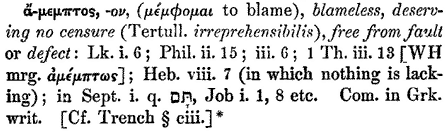
Here's what ANEMPTOS means according to Thayer's Lexicon:
Here is an illuminating bit of insight from Tony Hayling:
Luke 1:5-6 - In the days of Herod, king of Judea, there was a priest named Zacharias, of the division of Abijah; and he had a wife from the daughters of Aaron, and her name was Elizabeth. They were both righteous in the sight of God, walking blamelessly [Gk. ANEMPTOS] in all the commandments and requirements of the Lord
The commenter went on to draw this conclusion:
Unless you say you can be righteous in God's sight via IMPERFECT obedience to the Law, the only reason you can give for why these two people's obedience made them righteous in God's sight, is because God regarded their obedience as perfect.
Which means Luke 1:6 proves that sinners CAN (and often did) perfectly obey the Law of Moses.
So if you find some passage by Paul that says no sinner can keep the law perfectly, you've either misunderstood, or Paul is wrong, or Luke is wrong.I answered as follows:
You've brought up an interesting point that deserves attention. I think there is another alternative to your either/or scenario - is it possible we commonly misunderstand the meaning of "blameless"? You defined it as perfect obedience to the law, but I'm going to make a Biblical case that this is not the true meaning. We are naturally legalistic in our thinking, so we often impute shades of meaning to Biblical words that are not actually there. Open-hearted Bible study is the cure for this, and it's a cure we all need. The Bible is a document with amazing continuity and thematic resonance throughout its pages. God doesn't make mistakes, so things that appear contradictory can't be truly contradictory, and these seeming contradictions (a.k.a. paradoxes) often lead to a deeper understanding as we work through them. We are forced to look at things the way God does, and not with our man-made ideas. If we won't to do this, we can only distrust the Bible.
The approach you have taken is probably very similar to that which was taken by the early Judaizers who opposed the apostles. The Judaizers believed obedience to the Law was the way to righteousness. The tone of the whole New Testament, and indeed the entire Bible, is actually opposite to this, as I am about to show with regard to this word, "blameless."
First, let's consider three verses from David (not generally considered a "sinlessly" righteous man or a "blameless" man in terms of keeping all the requirements of the Law).
2 Samuel 22:24 - "I was also blameless toward Him, and I kept myself from my iniquity."
NOTE: He says my iniquity. So David's blamelessness did not equal sinlessness. David describes himself as both blameless and sinful. Or, better, blameless in spite of being sinful. We can and should carry this connection over to Luke 1:5-6.
Psalm 18:32 - "The God who girds me with strength and makes my way blameless?"
NOTE: David's blamelessness did not come from his own sinlessness or observance of the Law. It came from God's direct intervention in his life. He was depending on God, not his own performance (which obviously fell short at various times in his life - yet he said he was blameless toward God).
Psalm 19:13 - Also keep back Your servant from presumptuous sins; let them not rule over me; then I will be blameless, and I shall be acquitted of great transgression.
NOTE: Here blamelessness is described in terms of forgiveness rather than perfection or Law keeping. If blamelessness is a result of forgiveness, then it actually requires one to be a sinner prior to becoming blameless or righteous. This is a strong theme in the book of Matthew, where it is said that heaven rejoices more over one sinner who repents than it does over 99 who don't [think they] need to repent. Paul makes a similar point in Galatians 2:16-17. Again, Scripture has an amazing cohesiveness that can never be broken by any human reason - though many have tried.

Now let's trace blamelessness into the New Testament for some further examples.
Philippians 3:6 - as to zeal, a persecutor of the church; as to the righteousness which is in the Law, found blameless [Gk. ANEMPTOS].
NOTE: This is Paul's testimony of the life he lived before Christ rescued him. He was externally "blameless" and "righteous" in regard to the law, and yet that wasn't good enough. Later he says, "not having a righteousness OF MY OWN derived from the Law, but that which is THROUGH FAITH in Christ, the righteousness which comes from God on the basis of faith" (Php 3:9). Romans 7 shows us that somewhere along the line, Paul had a major battle with covetousness, to the point of calling himself "wretched." So, outwardly he may have been blameless all his life, but inwardly there was sin, and the Law provided no resources to change this. Even if there is perfect outward obedience (and apparently there was in the cases of Zechariah and Paul), there can never be perfect inward obedience because every person covets. It's impossible for any fallen human being to completely avoid breaking the 10th commandment, given enough time and opportunity. It happens all the time, but nobody else knows about it.
I Thess 3:12-13 - and may the Lord cause you to increase and abound in love for one another, and for all people, just as we also do for you; so that He may establish your hearts without blame [Gk. ANEMPTOS] in holiness before our God and Father at the coming of our Lord Jesus with all His saints.
NOTE: Here Paul gets to the heart of the matter, which is the heart. Rather than perfect outward obedience, Paul indicates that it is love - as it is given increase by God Himself - which makes our hearts blameless in holiness before Him. As Paul says elsewhere, "Love is the fulfillment of the Law." And love, I daresay, is the exact opposite of covetousness. So it is love, not perfect obedience, that fulfills the Law. And this does not happen SO WE CAN BE saved; it happens BECAUSE WE HAVE BEEN saved, by grace through faith on the basis of Christ's perfect inward and outward obedience.
"Blameless" outward observance of the Law is certainly achievable, but it cannot justify a person in God's sight. This is the limitation of the Law to which I am referring in the post. It is when the inward aspects are applied, e.g. the 10th commandment, that we see our need for a Savior who died for our sins. I do not deny that one can outwardly observe the Law, but with Paul I deny that any person can thereby please God or become righteous in His sight. It is faith alone that saves, by the grace of our loving and kind God, through the cross and resurrection of Jesus Christ.
Notice also, later in Luke 1, Zechariah was struck mute because he did not believe the angel's message. So, while he was outwardly blameless in observing the Law, he did not have the perfect and blameless heart that would trust the God Who must Himself sanctify all of our obedience, forgive all of our failure, and perfect all of our works. This is the Gospel, and it is continuously interlaced through the whole text of Scripture. I pray you may know the power of it, and be found truly blameless by Him on that day.
Thanks again for commenting. One quick question: the picture on your profile looks like a demon - is there some significance to this? I know that apart from Christ, I could never be anything more than a devil, with or without the benefit of the Law.
____________________________________________________
NOTES
Here's what ANEMPTOS means according to Thayer's Lexicon:

Here is an illuminating bit of insight from Tony Hayling:
We
know that Zechariah and Elizabeth were righteous in God's eyes in the
same way that Noah was. Noah found grace in the eyes of God. They, too,
were righteous through faith by grace. They were looking for the Hope
of Israel. The rest is the fruit of the grace of God towards them. The
operative word is GRACE.
Similarly, their observances and their obedience were fruit of the faith that the grace of God granted to them. The reason they were walking in all the commandments (moral law) and ordinances (ceremonial law) BLAMELESS is not because they were perfect and without blame, but because they were free from the weight of blame, being justified by faith in the promised Savior.
In other words they were as all believers are. They were sinners justified and regarded as blameless in God's eyes because of what God did (or, in their case, was about to do) and not because of what they did or would do.
Similarly, their observances and their obedience were fruit of the faith that the grace of God granted to them. The reason they were walking in all the commandments (moral law) and ordinances (ceremonial law) BLAMELESS is not because they were perfect and without blame, but because they were free from the weight of blame, being justified by faith in the promised Savior.
In other words they were as all believers are. They were sinners justified and regarded as blameless in God's eyes because of what God did (or, in their case, was about to do) and not because of what they did or would do.
Subscribe to:
Posts (Atom)